Halloween Games
Halloween games have deep historical roots that stretch back centuries, long before the modern celebrations seen in places like Boston today. Many of these games originated in ancient seasonal festivals such as Samhain, where the boundary between the living and the dead was believed to thin/dissipate. During this time, people engaged in rituals and playful activities that were often tied to divination, attempts to predict the future, particularly concerning love, marriage, and fate. These early practices laid the groundwork for many of the Halloween games that are still recognized today.
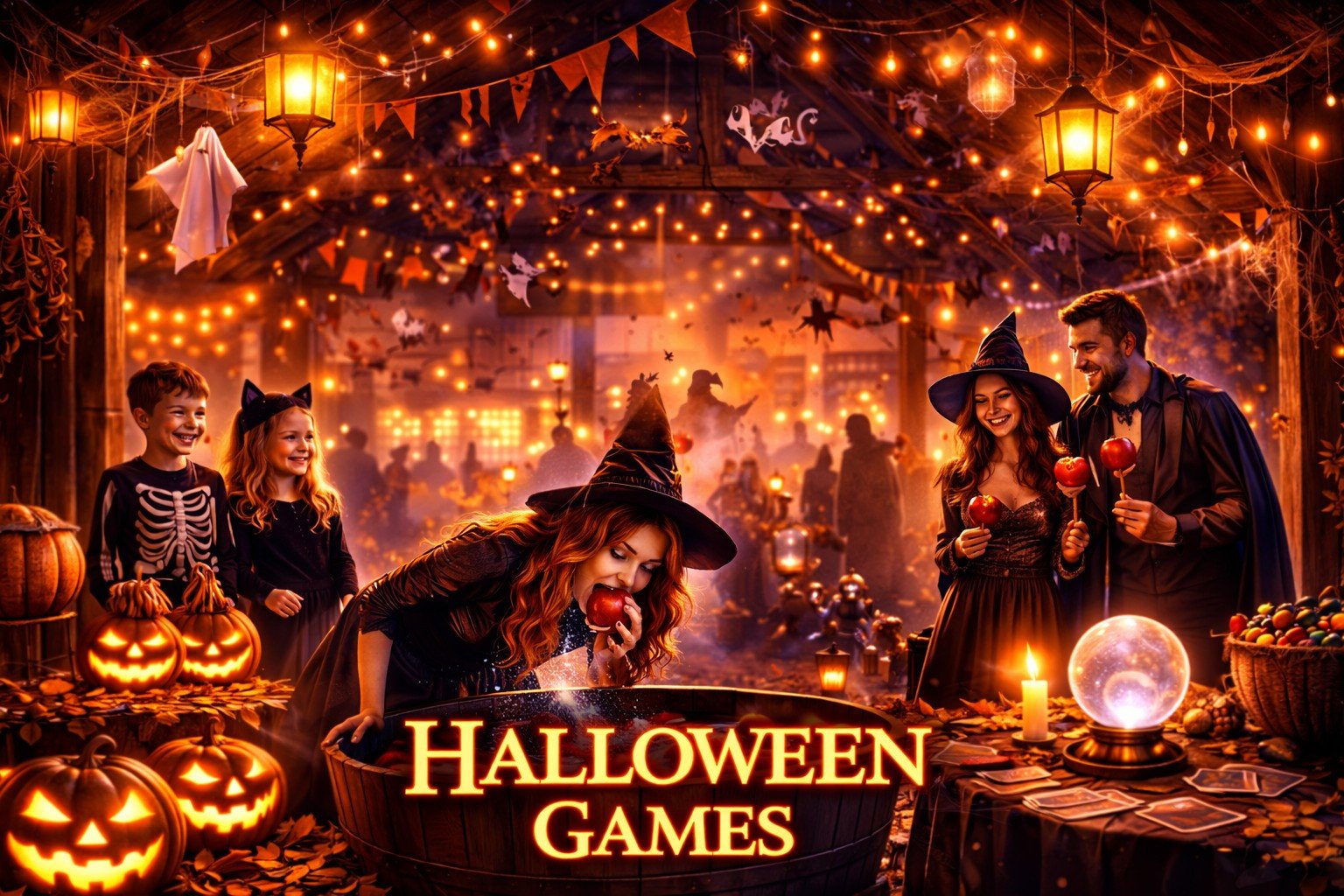
One of the most enduring traditions is bobbing for apples, a game that has its origins in Roman and later Celtic customs. Apples were associated with the Roman goddess of fruit and fertility, Pomona, and became symbols of love and abundance. In its early form, bobbing for apples was less about fun and more about fortune-telling. Each apple could represent a potential romantic partner, and successfully retrieving one was thought to reveal something about a person’s future relationships. Over time, as Halloween became more of a social and community-focused celebration, the game evolved into a playful activity that retained its symbolic roots while becoming accessible to all ages.
Another traditional game involved peeling an apple in a single continuous strip and throwing the peel over one’s shoulder. The shape it formed on the ground was believed to resemble the initial of a future spouse. Similarly, young people would place nuts or chestnuts in a fire, assigning each one to a person they were interested in. The way the nuts burned, whether they stayed close together or popped apart etc., was interpreted as a sign of compatibility or discord. These games highlight how Halloween once served as a time for exploring uncertainty about the future in a communal and often lighthearted way.
As Halloween traditions moved to North America through Irish and Scottish immigrants, these games were brought with them and adapted to new cultural contexts. In cities like Boston, where there was a strong influx of Irish immigrants in the 19th century, such customs became embedded in local celebrations. Over time, however, the emphasis shifted away from divination and toward entertainment. Halloween games became staples of parties, school events, and neighborhood gatherings, reflecting a broader transformation of the holiday into a family-friendly and socially oriented occasion.
In the context of “Halloween Boston,” these traditional games continue to influence modern celebrations, even if their original meanings are not always recognized. Activities like pumpkin carving contests, costume competitions, and scavenger hunts can be seen as contemporary extensions of earlier practices that combined creativity, chance, and social interaction. The communal aspect remains central, with games serving as a way to bring people together and create shared experiences.
Today, Halloween games in Boston are as much about atmosphere as they are about activity. Whether taking place at private parties, public events, or seasonal festivals, they contribute to the overall sense of occasion that defines the holiday. While the supernatural beliefs that once underpinned these traditions have largely faded, the underlying themes of mystery, transformation, and anticipation remain. In this way, Halloween games represent a living link between ancient practices and modern celebrations, connecting the past to the present in a way that continues to engage and entertain.