Boston Trick Or Treat
Trick-or-treating in Boston offers a unique blend of traditional Halloween charm and urban character, shaped by the city’s historic neighborhoods, community culture, and seasonal atmosphere. whilst the core idea remains the same, children dressing up in costumes and going door-to-door for candy, the experience in Boston has its own distinct rhythm and feel.
In many residential neighborhoods, particularly areas like Beacon Hill, the South End, and parts of Charlestown, trick-or-treating is a well-organized and highly anticipated event. Streets often become lively corridors of activity, with brownstones and historic homes decorated with pumpkins, lanterns, and subtle Halloween displays. Because these neighborhoods are more compact and walkable, families can cover a lot of ground in a relatively short time, making them especially popular destinations.
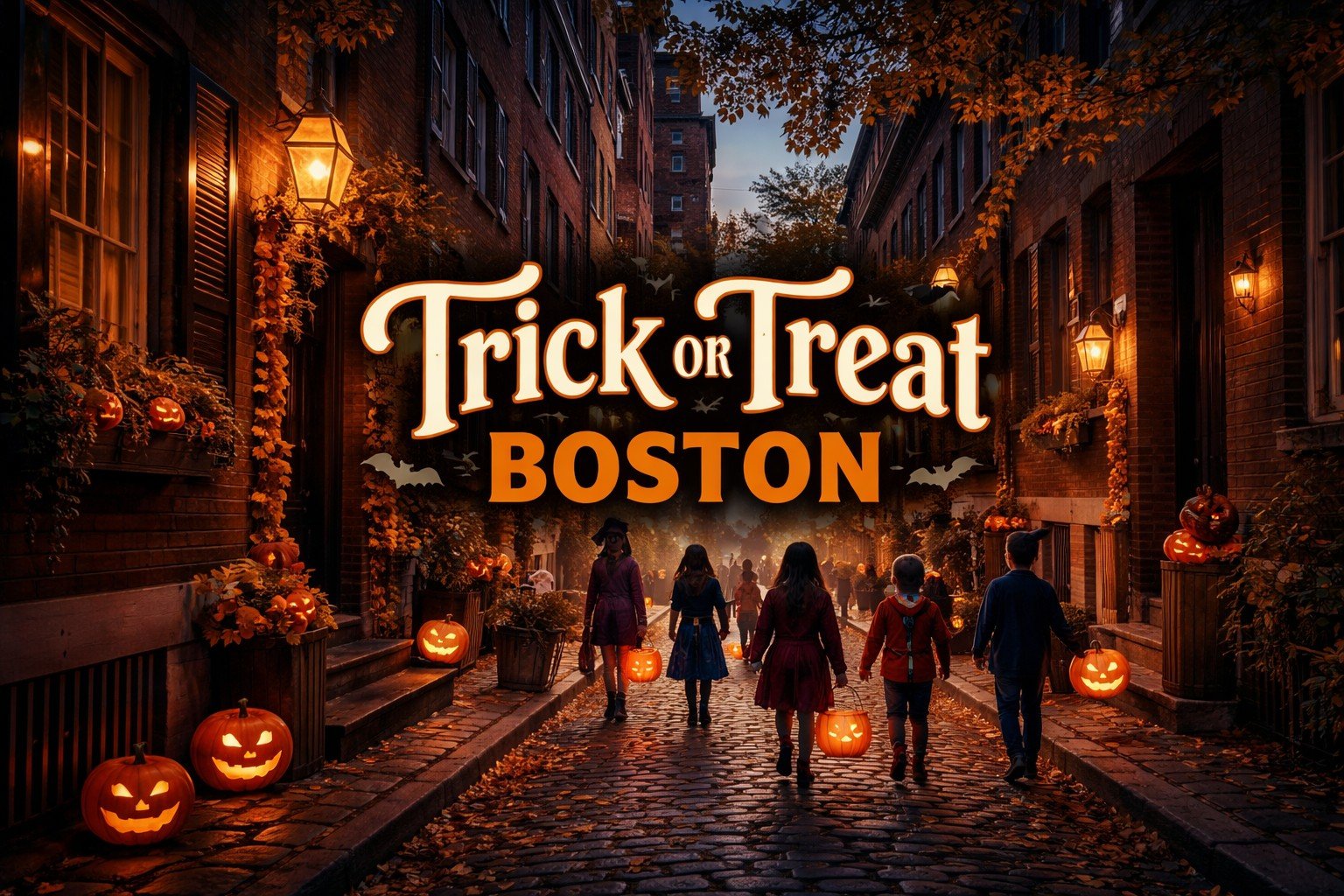
Beacon Hill, in particular, has developed a reputation as one of the city’s most iconic trick-or-treating locations. The narrow streets, gas-lit lamps, and brick sidewalks create an atmosphere that feels almost cinematic, adding to the sense of occasion. Residents often fully participate, handing out candy and embracing the festive spirit, which contributes to a strong sense of community engagement.
In other parts of the city, especially where residential density is lower or buildings are more spread out, trick-or-treating may take a slightly different form. Apartment buildings, community centers, and local organizations sometimes host indoor or organized alternatives, ensuring that children can still participate safely and enjoyably. Events like “trunk-or-treats,” where candy is distributed from decorated cars, have also become more common in certain areas.
Timing is an important factor. Trick-or-treating in Boston typically begins in the early evening, just before sunset, and continues for a few hours. The city’s cooler October weather adds to the experience, with costumes often layered over warmer clothing. Parents tend to accompany younger children, not only for safety but also as part of the shared experience, reinforcing the communal aspect of the tradition.
Safety and awareness are also part of the experience. Busy streets, traffic, and the urban environment mean that families often plan routes in advance, sticking to well-lit and heavily populated areas. Many neighborhoods coordinate informally, with residents signaling participation by leaving lights on or decorating their homes, helping guide trick-or-treaters to welcoming locations.
What makes trick-or-treating in Boston stand out is the combination of history, density, and community involvement. The city’s architecture and layout create an environment where the tradition feels both intimate and vibrant. At the same time, the diversity of neighborhoods means that the experience can vary significantly from one area to another, offering different interpretations of the same tradition.
Ultimately, trick-or-treating in Boston is about more than collecting candy. It’s a shared, seasonal ritual that brings together families, neighbors, and communities, set against a backdrop of one of America’s most historic cities. The blend of old-world atmosphere and modern celebration makes it a memorable part of Halloween in Boston.
Trick Or Treat Safety In Boston
We asked Boston-based security consultant, Gershon Ben Keren, about general trick-or-treat safety (we also asked him about other Halloween safety concerns in an interview which can be accessed by clicking here):
Trick-or-treating is widely considered a safe and enjoyable Halloween tradition, but like any activity involving children in public spaces at night, it carries certain risks. Understanding those risks, whilst keeping them in perspective, helps parents and communities create a safer environment without developing unnecessary fear.
One of the most persistent concerns is tampered or poisoned candy. Whilst this fear is deeply embedded in Halloween culture, research has shown that it is actually extremely rare. In fact, studies have found that most reported cases of candy tampering are either hoaxes or involve individuals within the child’s own household rather than strangers. However, there have been a small number of real incidents that continue to shape public perception.
One of the most infamous cases occurred in 1974, when Ronald Clark O’Bryan poisoned his own son with cyanide-laced Pixy Stix in an attempt to collect life insurance money. The child died after eating the candy, and several other children were put at risk . Earlier cases also contributed to concern, such as a 1959 incident in which a dentist distributed laxative-laced candy that made dozens of children ill . More recently, there have been isolated reports of foreign objects in candy, such as a 2025 case where a razor blade was found inside a candy bar, though no serious injury occurred. This means that it may be wise to stay away from bowls of candy that are left out on porches etc., and can potentially be tampered with, and only accept candy that a homeowner directly gives you.
Despite these examples, experts consistently emphasize that the greater risk on Halloween is not candy, but environmental hazards and in particular traffic. Children are significantly more likely to be injured in pedestrian accidents on Halloween night than harmed by tampered treats . The combination of darkness, costumes that limit visibility, and increased foot traffic creates conditions where accidents are more likely.
There are also risks related to stranger interaction and situational awareness. Trick-or-treating involves approaching unfamiliar homes and interacting with unknown individuals. Whilst serious incidents of this nature are extremely rare, children can become separated from groups, enter poorly lit areas, or encounter unsafe situations if not properly supervised. Trying to manage children in small groups helps reduce the chance of a child becoming separated from the group.
To reduce risk, several practical safety measures are widely recommended. Firstly, children should always trick-or-treat in groups or with an adult, particularly in urban environments like Boston where traffic and density increase complexity. Staying in well-lit, familiar neighborhoods and avoiding isolated areas helps maintain natural guardianship. Costumes should also allow for clear vision and include reflective elements or lights to improve visibility to drivers.